Monarch 4-D Rule: Your Questions Answered
Click for 4(d) rule he U S
OFF-SEASON PREP: THE 100+ MONARCH CHALLENGE GEAR CHECKLIST  To participate in our researcher-approved indoor protective rearing network this spring, you will need your gear prepped and ready before April. Use our official tracking links below to secure the exact equipment our community recommends (a small portion of your purchase supports our free educational movement!):
 The Enclosure: 2 Restcloud Pop-Up Mesh Habitats (2'x2'x3' size) Our organization receives 90 cents per hatchery sold
📷 Get them on Amazon here: https://link.amazon/B0bizO2YJ The Parasite Check: 1 Pocket Mini-Microscope (60x magnification) Watch a short 7 minute video https://butterfly-lady.com/what-is-oe/ We check the Female monarch before we introduce her to the enclosures above Get it here: https://link.amazon/B058wu53P Our organization receives 40 cents on each microscope sold.
Butterfly Net: Get it here: https://link.amazon/B09YQFasY
our organization receives 40 cents for each net sold
6 foot long Folding table: Get your table here: https://link.amazon/B09f1iIXs Our organization receives about 50 cents per table sold
Optional Plant Light to put on top of your indoor hatchery if you don't have a bright window with a table to set your hatcheries. These lights fit perfectly on the top of the 2x2x3' Restcloud popup mesh habitat linked above. We put the hatcheries in a spare bedroom on a bed on the collapsed table linked above https://www.homedepot.com/p/Feit-Electric-2-ft-32-Watt-White-LED-3-Adjustable-Spectrum-Linkable-Plant-Grow-Light-Fixture-GLP24ADJS-32W-LED/306744759
This item is available at Home Depot. Our organization doesn't receive any commission from the sale of these lights.
As an Amazon Associate, we earn a token amount from qualifying purchases This helps pay for this website and other expenses we have to maintain the largest monarch conservation organization in North America with over 2,000,000 affilliated members.
To get the full effect of the videos you may want to view this Ebook/ website on a laptop or desktop computer.
INCREASE THE MONARCH MIGRATION TAUGHT BELOW

IT'S A PROVEN FACT THE NUMBER ONE KILLER OF MONARCHS AND WHY YOU DON'T SEE AS MANY AS BEFORE IS NATURAL AND UNNATURAL PREDATORS CONSUME THEM DURING THEIR IMMATURE EARLY DEVELOPMENT STAGES. ONCE ADULTS THEY CAN FLY AWAY FROM DANGER
MONARCH BUTTERFLY ENTHUSIASTS IN CANADA ARE PRESENTLY LIMITED TO REARING 60 MONARCHS PER SEASON. Touching monarchs is illegal in California at this time.
Please read the following link: You can raise up to 250 monarchs in the U. S. every year except in California it's against the law to even touch them for some reason.
Questions and answers for monarch listing 4(D) rule
It has been determined by the U. S. Fish and Wildlife Service that the monarch butterfly population and it's spectacular migration occurring yearly involving the United States, Canada, and Mexico is threatened and endangered. 95+% of all monarch eggs, caterpillars, and chrysalis are consumed by increasing numbers of natural and unnatural predators before they become butterflies and are able to fly away and protect themselves. Of course, the natural predators are necessary for our wildlife food chain too. We increase necessary predators while we increase the monarch population.
WE TEACH YOU HOW TO PROTECT THE VULNERABLE EARLY STAGES OF THE MONARCHS DEVELOPMENT EARLY IN THE MIGRATION SEASON STARTING PROTECTING EGGS NO LATER THAN JULY 15th, IF POSSIBLE, SO THE GENERATION THAT NEEDS TO MIGRATE TO MEXICO DEVELOPS IN THE WILD SO THEY HAVE ALL THE TRAITS REQUIRED TO MAKE THE TRIP TO MEXICO, OVERWINTER, AND RETURN TO TEXAS AND THE SOUTH TO LAY EGGS TO START THE MIGRATION ALL OVER AGAIN
Our YouTube channel has over 300 videos starting with recent videos teaching how to protect monarch eggs from predators until they are adults and released to save and increase the monarch migration population.
https://www.youtube.com/@craigthebutterflyman4387/videos
Dr Lincoln Brower, the Xerces Sociey, Center for Food Safety, and Center for Biological Diversity Petitioned the U S Fish And Wildlife Service to modify the original petition to list the monarch butterfly as threatened by asking that households should raise up to 100 monarchs each season for conservation and education. The link to that petition modification request is here: https://img1.wsimg.com/blobby/go/8ef0052a-9ec6-4eb5-8373-35e15f18d1e4/downloads/monarch-esa-petition-4d-rule_61731%20(1).pdf?ver=1705591291171
The U S Fish and Wildlife service is proposing citizens be limited to raising 250 monarchs by citizens without a permit.
Currently there is no limit to how many monarchs can be raised in the U S except in California monarchs are not allowed to be touched by citizens
THE CANADIAN GOVERNMENT HAS ASK THEIR CITIZENS TO RAISE UP TO
60 MONARCHS each season
Below is the abstract of a study by top rated monarch butterfly scientist Dr David James and his wife Dr. Tanya James supporting protecting monarch eggs until they are adult butterflies and releasing them to help increase the spectacular monarch migration and monitor their movements.
The study is referenced and acclaimed in the following publication
https://ucanr.edu/blogs/blogcore/postdetail.cfm?postnum=27559
ABSTRACT. The fall migration of Monarch butterflies (Danaus plexippus) in the Pacific Northwest (PNW) was studied in an unfunded citizen science project during 2012–16 by tagging 13778 reared and 875 wild Monarchs. More than a third of these Monarchs were reared by inmates of the Washington State Penitentiary (WSP) in Walla Walla, Washington. Sixty (0.41 %) tagged Monarchs were recovered from distances greater than 10 km (mean: 792.9 ± 48.0 km) with most found in California, SSW of release points. One WSP-reared Monarch was found 724 km to the SE in Utah. Monarchs tagged in Oregon flew SSE to California. No Idaho-tagged Monarchs were found in California but two were recovered at locations due south. No wild tagged Monarchs from Washington, Oregon or Idaho were recovered. Monarchs from Washington and Oregon were found during October-February at 24 coastal California overwintering sites spanning 515 km from Bolinas to Carpinteria. A single wild spring Monarch tagged in May in northern California was recovered 35 days later and 707 km ENE in Twin Falls, Idaho. This study provides compelling evidence that many Monarchs in southern and central parts of Washington and Oregon migrate south in the fall to overwintering sites along the California coast. It also provides some evidence for southerly and south-easterly vectoring of migrating Monarchs from eastern Washington and Idaho, indicating the possibility of migration to Arizona or Mexico overwintering sites. In addition to improving our understanding of Monarch migration in the PNW, this study also contributed to conservation by adding nearly 14000 butterflies to the population. The incredible involvement of incarcerated and non-incarcerated citizen scientists generated much community and media interest which in turn led to greater involvement by citizens. Increased awareness of Monarchs, their biology and conservation in the PNW has been an unexpected but important spin-off of this study.
BELOW IS A PEER REVIEWED SCIENTIFIC STUDY AND RESEARCH DEMONSTRATING NATURAL AND UNNATURAL PREDATORS ARE THE NUMBER ONE KILLER OF MONARCHS KILLING OVER 95%+ WHILE THEY ARE DEVELOPING THROUGH THEIR VULNERABLE EARLY STAGES UNTIL THEY ARE ADULTS AND CAN FLY AWAY FROM DANGER.
https://www.nature.com/articles/s41598-019-50737-5
NATURAL MONARCH BUTTERFLY PREDATORS INCLUDING ANTS, WASPS, AND SPIDERS ARE ALSO NECESSARY IN THE WILDLIFE FOOD CHAIN.
THE MORE MONARCHS WE PROTECT AND RELEASE THE MORE THE ENTIRE WILDLIFE FOOD CHAIN BENEFITS
THE IMPORTED INVASIVE RED FIRE ANT HAS BEEN STUDIED AT THE UNIVERSITY OF TEXAS AT SAN ANTONIO AND PROVEN TO CONSUME 87% OF THE VULNERABLE EARLY DEVELOPMENT STAGES OF
MONARCH BUTTERFLIES. LEARN ABOUT THESE UNNATURAL PREDATORS HERE: https://youtu.be/R7pEAUUqmM0?si=EofO6CvLn51w_TGk
IMPORTED INVASIVE RED FIRE ANTS ARE PRESENT AND ACTIVE IN MOST OF THE STATE OF TEXAS, ALL OF THE SOUTHERN STATES, AND CALIFORNIA WHEN MONARCHS RETURN FROM MEXICO IN THE SPRING AND LAY EGGS.
https://youtu.be/8DmnM_oFNx8?si=1YEgv6LJi2ydh91z
THESE FIRE ANTS CAN"T SURVIVE IN CLIMATES WHERE THERE ARE EXTENDED FREEZES ! THIS IS WHY WE PROTECT EGGS WHERE THERE ARE LONG PERIODS OF FREEZING TEMPERATURES
so these ants won't eat the monarchs early immature stages of development.
OFF-SEASON PREP: THE 100+ MONARCH CHALLENGE GEAR CHECKLIST To participate in our researcher-approved indoor protective rearing network this spring, you will need your gear prepped and ready before April. Use our official tracking links below to secure the exact equipment our community recommends (a small portion of your purchase supports our free educational movement!):
- The Enclosure: 2 Restcloud Pop-Up Mesh Habitats (2'x2'x3' size) Our organization receives 90 cents per hatchery sold
📷 Get them on Amazon here: https://link.amazon/B0bizO2YJ - The Parasite Check: 1 Pocket Mini-Microscope (60x magnification) Watch a short 7 minute video https://butterfly-lady.com/what-is-oe/ We check the Female monarch before we introduce her to the enclosures above Get it here: https://link.amazon/B058wu53P Our organization receives 40 cents on each microscope sold.
Butterfly Net: Get it here: https://link.amazon/B09YQFasY
our organization receives 40 cents for each net sold
6 foot long Folding table: Get your table here: https://link.amazon/B09f1iIXs Our organization receives about 50 cents per table sold
Optional Plant Light to put on top of your indoor hatchery if you don't have a bright window with a table to set your hatcheries. These lights fit perfectly on the top of the 2x2x3' Restcloud popup mesh habitat linked above. We put the hatcheries in a spare bedroom on a bed on the collapsed table linked above https://www.homedepot.com/p/Feit-Electric-2-ft-32-Watt-White-LED-3-Adjustable-Spectrum-Linkable-Plant-Grow-Light-Fixture-GLP24ADJS-32W-LED/306744759
This item is available at Home Depot. Our organization doesn't receive any commission from the sale of these lights.
As an Amazon Associate, we earn a token amount from qualifying purchases This helps pay for this website and other expenses we have to maintain the largest monarch conservation organization in North America with over 2,000,000 affilliated members.
To get the full effect of the videos you may want to view this Ebook/ website on a laptop or desktop computer.
YOU MUST KEEP YOUR HATCHERY AND ANY OTHER EQUIPMENT DISINFECTED BEFORE AND AFTER YOU RAISE MONARCHS IN IT SO YOU DON'T RELEASE UNHEALTHY MONARCHS INTO THE MIGRATION. .
THIS IS WHY WE TEACH RAISING UP TO 50 AT A TIME IN THE LARGE HATCHERY BECAUSE IT WILL KEEP YOU FROM ADDING INFECTED EGGS AND/OR CATERPILLARS INTO THE HATCHERY. WHILE OTHER BUTTERFLIES ARE IN DIFFERENT STAGES OF DEVELOPMENT
TO DISINFECT YOUR HATCHERY AND OTHER EQUIPMENT COLLAPSE YOUR HATCHERY INTO A CIRCLE AND COMPLETELY SUBMERGE IT IN A 1 PART UNSCENTED HOUSEHOLD BLEACH AND 4 PARTS WATER SOLUTION FOR 12 HOURS. REMOVE THE HATCHERY AND RINSE IT THOROUGHLY WHILE IT IS STILL COLLAPSED AND OPEN IT AND LET IT DRY.
WE TEACH YOU HOW TO PROTECT THE VULNERABLE EARLY STAGES OF THE MONARCHS DEVELOPMENT EARLY IN THE MIGRATION SEASON STARTING PROTECTING EGGS IF POSSIBLE NO LATER THAN JULY 15th, IF POSSIBLE, SO THE GENERATION THAT THEY PRODUCE NEEDS TO MIGRATE TO MEXICO AND NEEDS TO DEVELOP IN THE WILD SO THEY HAVE ALL THE TRAITS REQUIRED TO MAKE THE TRIP TO MEXICO, OVERWINTER, AND RETURN TO TEXAS TO LAY EGGS TO START THE MIGRATION ALL OVER AGAIN
We promote American Beauties Native Plants ! If you're looking to purchase native stock plants for your garden and propagation, these are great perennial plants that can be bought at over 1000 garden centers and on Amazon.
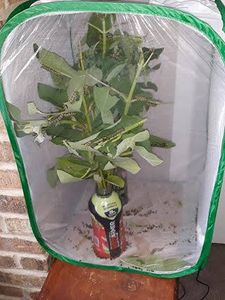
YOU CAN COLLECT STEMS WITH EGGS ON THEM OR IT'S BETTER, IF POSSIBLE, TO ACTUALLY NET A MONARCH YOU SEE LAYING EGGS AND PUT HER INTO YOUR HATCHERY AS PICTURED ABOVE. SHE WILL LAY EGGS ON YOUR BOUQUET OF MILKWEED OVER THE NEXT COUPLE OF DAYS. IT SAVES YOU A LOT OF TIME LOOKING FOR EGGS ON MILKWEED LEAVES. THIS IS A SHORT VIDEO SHOWING MONARCHS LAYING EGGS ON MILKWEED. LINKED HERE" https://youtu.be/UsgZd8cFJOg?si=-3CTX_TWNgDUhg0G
The "common" milkweed in the Midwest and Northeast is 2 feet tall in the Midwest and Northeast by June 1st as shown in this video. It's ready to harvest to put in your one gallon milk jugs in your netted pop up hatcheries you place near a window ona table indoors.
You will add a female that you net when you see her laying eggs.
https://youtu.be/QUni-F01YgY?si=pHLB31LGz4Epe4KE
If you want to find monarch eggs on milkweed or net a monarch laying eggs to put in your hatchery to lay eggs, this is what common milkweed looks like at 4-5 feet high in mid July. The first of June it's about 2' tall in the Midwest and Northeast.
watch this: https://youtu.be/HiYObguY1XI?si=K7BeuoTxri4xk9qk
Here's another video that shows you how to identify common milkweed that's found in the Midwest and Northeast and it's about 2' high by the first of June.
The common milkweed in this video is about 5' high and it's about the middle of July" https://youtu.be/-FPIX5Wb5w4?si=5Uhpywew_63LiAVB
NEVER TOUCH THE MILKWEED AND/OR SAP AND RUB YOUR EYES OR FACE. THE SAP CONTAINS AN IRRITANT. IMMEDIATELY RINSE YOUR EYES AND SKIN AFTER TOUCHING THE MILKWEED AND/OR SAP !
1) If you're new or just want to share the miracle of the monarchs"metamorphosis" , we teach you can raise one monarch on a milkweed stem with 10 leaves , with an egg on a leaf immersed in a disposable paper cup with a lid and a straw hole, full of water, setting on a paper towel indoors near a window as shown above. That's easy peasy and FREE
THE STEMS MUST BE IMMERSED IN THE WATER IMMEDIATELY AFTER THEY ARE RINSED AND SPLIT AT THE BOTTOM TO STAY FRESH.
BEFORE YOU RELEASE YOUR MONARCHS YOU SHOULD ALWAYS CHECK THEM FOR OE LIKE THE BUTTERFLY LADY TEACHES HERE: http://butterfly-lady.com/what-is-oe/
GOOGLE: $2 - 40x power mini-microscope free shipping
NOW YOU'RE A SCIENTIST ;)
If you have more than one egg on a stem with 10 leaves you can carefully roll the egg with your thumb off the leaf and put some milkweed sap on a leaf of another stem that doesn't have and egg and use the white milkweed sap to stick the egg to the leaf.
NEVER TOUCH THE MILKWEED AND/OR SAP AND RUB YOUR EYES OR FACE. THE SAP CONTAINS AN IRRITANT. IMMEDIATELY RINSE YOUR EYES AND SKIN AFTER TOUCHING THE MILKWEED AND/OR SAP !
2) You can also collect more stems with eggs on them and put them in more cups and share them with friends, take them to schools, or watch them develop into adult monarchs yourself, check them for OE, and if healthy, release them so they will breed in the wild and produce more healthy monarchs that develop in the wild that wouldn't have existed without originally protecting there mother from predators.
Each healthy monarch you raise and release wil be responsible for about 15 monarchs in the next generation
NEVER TOUCH THE MILKWEED AND/OR SAP AND RUB YOUR EYES OR FACE. THE SAP CONTAINS AN IRRITANT. IMMEDIATELY RINSE YOUR EYES AND SKIN AFTER TOUCHING THE MILKWEED AND/OR SAP !
The monarch hasn’t been listed under the ESA yet so there’s no regulations on handling monarchs or limits on the number you raise except in California. Below is the exact wording of the document sent to USFWS .
In Canada you need a permit to protect up to 60 monarchs until they are adults and can fly and avoid predators.
_______________________________________________________________________________________
ENDANGERED SPECIES ACT PROTECTION
Citizen Handling of Monarchs Protected Under
Endangered Species Act Petition
The Center for Biological Diversity and Center for Food Safety as co-lead petitioners joined by the Xerces Society for Invertebrate Conservation and Dr. Lincoln Brower petitioned the U.S. Fish and Wildlife Service to protect the monarch butterfly as a threatened species under the Endangered Species Act. The petitioners suggested that the Service adopt a “4(d) rule” to allow citizens, educators, and scientists to continue to handle monarch caterpillars and butterflies even if the monarch becomes a protected species.
WHAT IS A 4(D) RULE? Under the Endangered Species Act, monarchs can be federally protected as either “endangered” or “threatened.” When an animal is protected as “threatened,” the U.S. Fish and Wildlife Service can adopt a 4(d) rule to issue regulations deemed “necessary and advisable to provide for the conservation of threatened species.” Typically the Service uses 4(d) rules to incentivize positive conservation actions and to streamline the regulatory process for actions that would have minor impacts on the species. A 4(d) rule is often used to clarify or simplify what actions are and are not prohibited towards the species.
PETITIONERS HAVE SUGGESTED A 4(D) RULE THAT WOULD ALLOW HANDLING OF MONARCHS TO CONTINUE. To facilitate monarch butterfly conservation, science, citizen monitoring, and education, the petitioning groups requested that the Service adopt a 4(d) rule that would allow wild-captured monarchs and caterpillars to be reared in classrooms and nature centers and that would allow scientific research, citizen monitoring, and beneficial household rearing endeavors to continue without the need for a permit. The petitioners originally suggested that individuals, households, and educational entities be allowed to collect ten wild caterpillars per year for rearing purposes, but they increased the suggested number to 100 in comments submitted to the Service during the public comment period on the initial positive finding on the petition. Ultimately, should the Service list the monarch as threatened and develop a 4(d) rule, the content of this rule would be at the discretion of the Service.
PETITIONERS HAVE CONCERNS ABOUT THE RELEASE OF COMMERCIALLY-BRED MONARCHS. Petitioners have requested that only wild caught monarchs and caterpillars be eligible to be handled without a permit. There are scientific concerns shared by many researchers about the potential spread of disease and genetic problems from the release of commercially-bred monarchs. In light of this concern, petitioners requested that only wild-caught monarchs be exempted from normal permitting requirements.
______________________ ______________________________________
WE TEACH TO PROTECT THE VULNERABLE DEVELOPMENT STAGES OF MONARCH BUTTERFLIES INDOORS IN A NETTED POPUP HATCHERY HABITAT, NEAR A WINDOW, CHECK THEM FOR OE, THEN RELEASE HEALTHY ADULT MONARCHS (THAT CAN PROTECT THEMSELVES ) TO BREED AND REPRODUCE IN THE WILD TO CREATE A LARGER MIGRATION POPULATION
PLEASE SHARE THIS WEBSITE PAGE ON YOUR FACEBOOK FRIENDS TIMELINES !!!


OFF-SEASON PREP: THE 100+ MONARCH CHALLENGE GEAR CHECKLIST To participate in our researcher-approved indoor protective rearing network this spring, you will need your gear prepped and ready before April. Use our official tracking links below to secure the exact equipment our community recommends (a small portion of your purchase supports our free educational movement!):
- The Enclosure: 2 Restcloud Pop-Up Mesh Habitats (2'x2'x3' size) Our organization receives 90 cents per hatchery sold
📷 Get them on Amazon here: https://link.amazon/B0bizO2YJ - The Parasite Check: 1 Pocket Mini-Microscope (60x magnification) Watch a short 7 minute video https://butterfly-lady.com/what-is-oe/ We check the Female monarch before we introduce her to the enclosures above Get it here: https://link.amazon/B058wu53P Our organization receives 40 cents on each microscope sold.
Butterfly Net: Get it here: https://link.amazon/B09YQFasY
our organization receives 40 cents for each net sold
6 foot long Folding table: Get your table here: https://link.amazon/B09f1iIXs Our organization receives about 50 cents per table sold
Optional Plant Light to put on top of your indoor hatchery if you don't have a bright window with a table to set your hatcheries. These lights fit perfectly on the top of the 2x2x3' Restcloud popup mesh habitat linked above. We put the hatcheries in a spare bedroom on a bed on the collapsed table linked above https://www.homedepot.com/p/Feit-Electric-2-ft-32-Watt-White-LED-3-Adjustable-Spectrum-Linkable-Plant-Grow-Light-Fixture-GLP24ADJS-32W-LED/306744759
This item is available at Home Depot. Our organization doesn't receive any commission from the sale of these lights.
As an Amazon Associate, we earn a token amount from qualifying purchases This helps pay for this website and other expenses we have to maintain the largest monarch conservation organization in North America with over 2,000,000 affilliated members.
To get the full effect of the videos you may want to view this Ebook/ website on a laptop or desktop computer.
• 5-gallon bucket: about $4
• Stem cutters for ¾-inch stems
• Unscented household bleach: about $5
• Clear tape and paper towels
• One to three 1-gallon milk jugs
• Spray bottle: about $1
• Thin rubber gloves
A simple setup costs about $25; a larger setup is around $40. Prices may vary, and you may already have some supplies or a suitable netted habitat. Choose equipment that fits your needs, and follow safe cleaning and handling practices as you care for monarchs.

My indoor monarch hatchery method has been observed by U.S. Fish and Wildlife biologists and butterfly experts, and is used by citizen scientists around the world. Watch the video: https://www.youtube.com/watch?v=HVcAFLLJRBU
Here’s a simple overview of raising one generation of monarchs each year. After June 1, find common milkweed where monarchs are laying eggs. Follow local wildlife guidance and handle butterflies gently. Gather fresh milkweed stems, rinse them well, trim and split the bottom of the stems to keep them fresh and immediately place them in a one gallon milk jug full of water. As the leaves get striped add more bouquets of milkweed in jugs next to the striped milkweed jugs so the caterpillars can migrate to fresh stems When the caterpillars have eaten enough milkweed they will migrate to the top of the hatchery and form chrysaleses.
Check the leaves regularly for eggs and caterpillars. As caterpillars grow, keep the hatchery clean and monitor the caterpillars as they form chrysalises. Monarchs typically emerge about 10–12 days later. Once their wings have fully dried, release them outdoors near flowers in suitable weather.
Share what you learn with friends and fellow nature lovers. For more guidance, visit www.HowtoRaiseMonarchButterflies.com. Keep milkweed stems in water so the leaves stay fresh, and follow current expert advice for responsible monarch care.

Keep replacing eaten milkweed with fresh, rinsed stems so the leaves remain a healthy food source. When caterpillars are ready, they climb to the top of the hatchery, hang in a “J” shape, and form a green chrysalis. In about 10–12 days, a butterfly may emerge. Allow its wings to dry fully before release outdoors in suitable weather.
After use, clean the hatchery carefully and follow its manufacturer’s directions for disinfection and storage. Good care at every stage helps you observe the monarch life cycle while keeping the butterflies’ wellbeing in mind.
Care for potted milkweed by giving it plenty of sunlight, regular water, and appropriate fertilizer during the growing season. If plants need cleaning, use a method recommended by a trusted gardening or extension resource, then rinse thoroughly. Healthy, growing milkweed provides the fresh leaves monarch caterpillars need.
Grow a Garden for Monarchs
THE FOOD WEB OF WILDLIFE
Of course, without the native cold and drought tolerant taproot plants on the landscape, life as we know it wouldn't exist on our planet. Monarch butterflies and other beautiful pollinators live on these plants and also help propagate most of the same plants they thrive on.
In the food web of life, other creatures up the wildlife food chain live on eating pollinators just like predators consume the first three stages of the monarchs development and eat parts of the adult butterfly after it dies. Only about 2-5 % of the monarch eggs laid get to the adult in flight stage which makes protecting those early stages of the monarchs necessary using our protecting monarchs from predators hatchery/nursery rearing method if we are going to add to insect population when we release them and they reproduce.
The following link is an online book that explains butterfly gardening and the plants they need. Please download it and enjoy https://tomterrific1.files.wordpress.com/2013/12/butterfly-gardening.pdf
If you're looking for native plants to buy at a garden center or online Google American Beauties Native Plants and you can learn about this National plant branding program.
Learn More
I'm Known as Craig the Butterflyman. I'm your educator. Please let me introduce myself in this short video https://www.youtube.com/watch?v=jfn9wuvVaDw&t=4s
Help monarchs thrive by raising up to 100 butterflies each year for conservation and education. Learn how caring for these remarkable pollinators can make a difference.
Connect with fellow monarch enthusiasts and discover local events. Find your people and bring your love of butterflies into the community.